I’ve been meaning to reflect on Zen and the Art of Motorcycle Maintenance (often abbreviated to ZAMM) by the late Robert Pirzig, in part because it just begs to be reflected on, but also because I noticed quite a large number of people online struggling to understand the concepts it presents. Frustration with the book often stems from misinterpretation, and while I have sympathy for the (I’m assuming) majority of people who simply bounced off this book, I do feel that most of the confusion around it could be easily eliminated by reading at a slower pace, like I tried to do. For anyone who has not yet attempted to read it, I cannot recommend it enough and reading a chapter or two has proven to be almost as relaxing as meditation. I can also assure you that reading this essay before the book does not detract anything from the experience of a first reading. In truth, it would be impossible to “spoil” this book in any real way, because reading it is a wholly unique experience.
For those unfamiliar with the book but have perhaps heard of it here and there, the book is not about motorcycle maintenance, at least in the “traditional” sense, and I’m also getting the sense that the title alone may have been the cause of a lot of derision. It is not a book about how to maintain a motored vehicle (in fact, I remember only two passages with notably technical terms), but it is a book about how we understand how to maintain anything. Even more, it is a book about how we know anything. An analysis or discussion of the book is all but incomplete without directly referencing the text, because it is far too dense and broad in scope to be pinned down to any one topic. The book is told through alternating between passages about Pirzig and his son going on a cross-country road trip and nearly direct transcriptions of Pirzig’s train of thought as they take their journey. His thoughts seem to be centered around, among other things, this ephemeral sense of “Quality,” and this is what I would like to focus on here.
When I first encountered this term (Quality, with a capital ‘Q’), I was confused as to what it could be referring to. I had already gotten into the headspace that this was a philosophy book by the time the term appeared, so I naturally assumed that it must be some undefinable property that has some esoteric connection with reality – something that could be understood through rigorous analysis but not immediately obvious. Turns out I was right about the undefinable part, but Pirzig is quick to point out that everyone knows what quality is. It’s the pleasant smell of a new flower, an impressive academic paper, a nicely designed residential neighborhood. Put simply, it’s all things we find “good.” Adding the capital letter to create Quality just emphasizes that this obvious property is more than we give it credit for.
Pirzig was particularly interested in what Quality is precisely because it can not be defined. He argued we all know quality when we see it, but we can never define quality in an all-encompassing way. Then when he began searching for what Quality is, he came to a conclusion that feels outright radical; Quality is reality. That might seem to come out of nowhere (because the book is so dense and the arguments so meticulous), but if you examine what reality is doing at every level it becomes so obvious. Chemicals react with each other to form new compounds and reach a more structured form. Life lives and dies endlessly in the pursuit of becoming more efficient than the competition. Stars swirl to form galaxies that are brighter and more gravitationally dense. Reality is a series of constant decision-making, and the outcomes of these decisions always tend towards a more stable universe in the long run. A higher Quality universe.
Now, I doubt Pirzig would agree with my crude interpretation of his analysis, as it seems he had a much more human-centric perspective on Quality and what it means for human understanding. That’s not to say he believed humans were exceptional or apart from the rest of the universe in any way, but more that humans can’t know more than their own limitations, so he focused on understanding those limitations. Put in a more human context, Quality is simply what you strive towards to be good at whatever you are doing. To paraphrase a part of the book, you can never really want to do a bad job at anything; you either want to do that job well or not want to do it at all. For example, infants begin walking with very limited capability at the start, but they don’t need to be taught what good walking is from bad walking. They simply know how to improve their stride as they age.
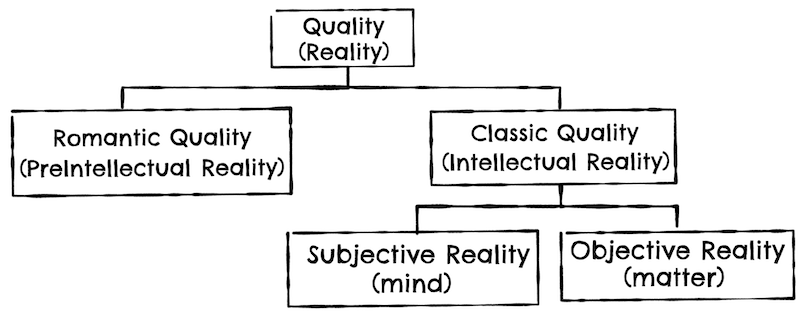
Figure 1: Pirzig's diagram of reality.
In the book, the diagram showed in Figure 1 is presented as Pirzig’s own model for how reality functions. I believe what I have just described with the infant example would be called “Romantic Quality” by Pirzig, meaning no introspection is needed to come to these conclusions because they are self-evident. Another example would be knowing that it is pleasant to take a nap in the shade on a sunny day, or that nature is beautiful. These are things we do not needed rigorous problem-solving skills to work out. Conversely, “Classic Quality” can be classified as anything from simple algebra to taking mentally checking items off a grocery list. These are things that do require some level of attention and mental consistency, and the result may or may not be obviously true. Interestingly enough, Pirzig places both subjectivity and objectivity within the category of “Classic Quality,” but this actually makes perfect sense under close examination. After all, how do we define a subjective experience and an agreed-upon reality without at least a little analysis first?
In addition to the overarching concept of Quality, reframing of Subjective and Objective Reality is one of the more beautiful concepts the book offers. Whenever I discuss this concept with friends, it never feels quite right to them. They understand that we need to analyze the world first before we can define it, but placing Objective Reality within our faculty for reason feels a bit crude. A common objection is that we all agree upon some shared reality, so objectivity must exist beyond the human experience – and that’s exactly the point. Quality is that existence beyond human experience! Put another way, our senses have some time delay to process the constant stream of stimuli being collected, and even light has a maximum speed at which it can travel. Everything we experience is in the past, so our conceptions of reality will always be an approximation of the true thing! We get so wrapped up in creating experience from our senses that we forget that senses can never truly imitate the information they are receiving. Something is always being left out.
This essay is long-winded already and really isn’t going anywhere (I mainly wanted to write out the thoughts I was collecting through my time reading), but I’ll leave it on something that I find downright elegant about this lens to view the world through. People always talk about some kind of “objective” reality as if it is self-evident what that means, but that term seems almost incongruous with our world. If someone travels across the universe at near light-speed, and they only age a day while the universe aged a millennium, how much time has really passed? Viewing galaxies from millions of years ago in the night sky, are we millions of years in the past or are those galaxies millions of years in the future? In order to establish some true “objectivity”, we would need to decide a reference point to latch onto, some anchor to underpin our explanation. But with Quality, Pirzig removes that barrier entirely and the universe becomes a chaotic soup of endless possibilities, always striving towards a more orderly form, towards whatever just feels right.
-JRW